

Blogs
Date 30 September 2020
Estimated read time: 2 minutes


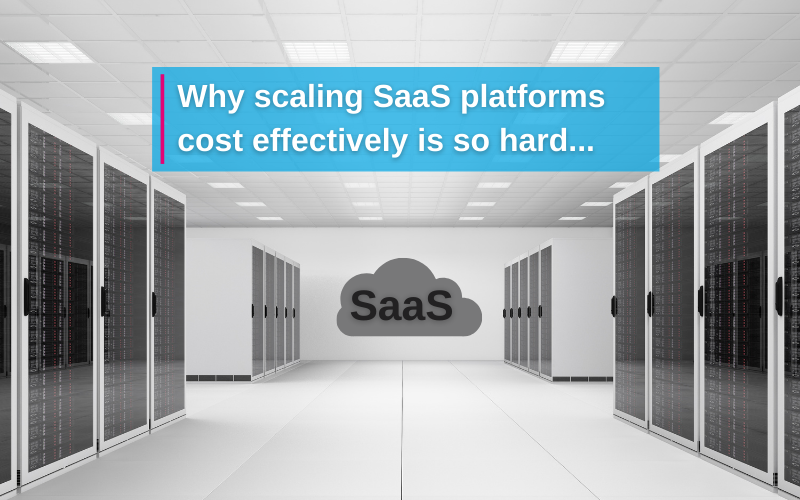
Scaling of eCommerce sites is relatively easy - scaling a SaaS service is much harder for the following reasons:
- Demand is outside of your control
- Some users have disproportionate impact on capacity
- Reluctance to change existing sizing models
- Setting and delivering the customer promise on performance
Demand is outside of your control
An ecommerce business may not know exactly how users will behave, but it's largely in the control of the marketing department. SaaS providers don't have control over how they behave - for instance if the service is an ecommerce platform, you have no control over the customers' marketing teams.
Some users have disproportionate impact on capacity
The capacity impact on an ecommerce site is very collective as it's based on a large number of users, each with a small impact. However for a SaaS service, there will be customers who have a much larger individual impact on capacity, making it much harder to predict and manage hosting cost.
Reluctance to change existing sizing models
The uncertainty around demand results in a reluctance to change existing sizing models. In our experience, SaaS providers tend to oversize because of a lack of confidence in performance. Capacity (and therefore cost) will be wasted in the wrong places, while customers still experience performance incidents, because the business of getting the capacity right is so complex and full of uncertainties.
Setting and delivering the customer promise on performance
Most SaaS providers make very little commitment to customers on performance. It's common for SaaS services to have no performance SLAs at all, or a very minimum commitment. In our experience this is driven by a lack of confidence in performance within the SaaS provider. It results in poor trust with customers and blame being shifted onto the SaaS provider.
To deliver a scalable, cost effective SaaS platform, which meets customers' performance expectations, is difficult. You need to start with deeper insights into customer types, their performance and behaviour.
Schedule a Cloud Opportunity and Risk Assessment Call
View Free, Relevant Capacitas Insights
Whether you’re looking to optimise costs, improve agility or drive value creation, our expert insights can help you. Ready to start?

About the author
Thomas Barns

FinOps and AI: Building the Financial Discipline for the Next Wave of Enterprise Intelligence
AI FinOps represents an evolution rather than a replacement of traditional FinOps. It extends the model into a domain where financial, technical, and product decisions are tightly interconnected.
Confidence Under Load: How We Verified AKS Readiness for Peak
How Capacitas verified AKS readiness for peak demand by validating workload performance, autoscaling, cluster capacity, monitoring, and incident response.
Building Cloud Resilience: Lessons from the AWS Outage
Learning from the Latest Outage. Events like this week’s AWS disruption highlight one clear truth: resilience must be designed, not assumed.
Bringing Order to Chaos: A Practical Guide to Chaos Testing in the Cloud
In today’s cloud-native environments, resilience is not optional—it’s critical. Chaos testing has emerged as a key practice for validating system behaviour under failure conditions.