

Blogs
Date 29 June 2026
We are often asked: “How can online stores best deal with peak sales periods?" Perhaps the most important part of coping with peak is good preparation, in good time.
Website crashes come with revenue loss and human resource overhead of managing the incident, not to mention the brand damage and reputational impact. Knowing when your sites will receive high levels of traffic and preparing well in advance can prevent the site meltdown nightmare.
Start Early!
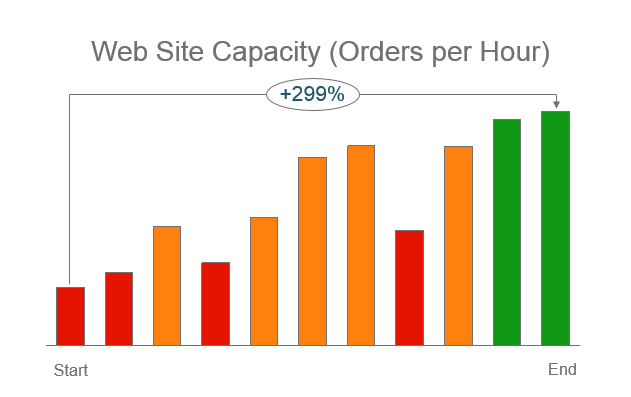
A recent engagement with a multi £billion online retailer highlights the importance of starting preparation for peak trading periods early. Their requirement was to process 12,000 orders in the peak hour on Black Friday.
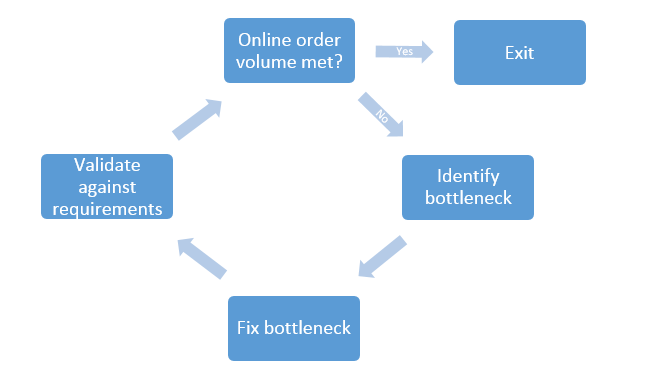
When our engagement commenced in the preceding April, we demonstrated that their website could only handle 3,200 orders in the peak hour. Using our Service Assurance and Demand & Supply Modelling services, we discovered an IT system bottleneck that caused the site to crash beyond 3,200 orders. Once we identified and fixed the bottleneck the web site scaled to 4,000 orders. A second bottleneck was now preventing us from scaling further. And so the process continued to eliminate the immediate bottleneck and find the next bottleneck, and so on.

Over the course of the engagement we delivered 16 major fix-test cycles in order to achieve our goal.
As you can imagine, a significant amount of engineering was required to deliver a four-fold increase in order capacity. Each time a bottleneck is identified, we needed to work with the developers of the system to elaborate defect causing the bottleneck and identify a fix. This takes time with large, complex systems. We achieved our goal but it took 6 months to get there!
The scenario described above was where the bottlenecks were in the code and configuration of the ecommerce system. In other client engagements, we have discovered bottlenecks in the IT infrastructure capacity, or hardware of the web site. The selection, procurement, installation and commissioning and testing of new IT servers takes weeks not days. The adoption of cloud computing negates this somewhat.
Also remember that your ecommerce web site is probably comprised of third-party systems such as payment service providers, a packaging and delivery provider, fraud prevention and in some cases ancillaries. Any one of these can bottleneck during peak trading periods, causing a web site crash. In our experience, it can take a significant amount of time to resolve third-party bottlenecks.
All in all the earlier you start the better, and for complex, high-revenue web sites a programme of work of at least 6 months is typical.
If you would like to learn more about our Prepare for Peak and Performance testing solutions, please click below, to see our latest Ebook.


About the author
Team Capacitas

FinOps and AI: Building the Financial Discipline for the Next Wave of Enterprise Intelligence
AI FinOps represents an evolution rather than a replacement of traditional FinOps. It extends the model into a domain where financial, technical, and product decisions are tightly interconnected.

Confidence Under Load: How We Verified AKS Readiness for Peak
How Capacitas verified AKS readiness for peak demand by validating workload performance, autoscaling, cluster capacity, monitoring, and incident response.
Building Cloud Resilience: Lessons from the AWS Outage
Learning from the Latest Outage. Events like this week’s AWS disruption highlight one clear truth: resilience must be designed, not assumed.
Bringing Order to Chaos: A Practical Guide to Chaos Testing in the Cloud
In today’s cloud-native environments, resilience is not optional—it’s critical. Chaos testing has emerged as a key practice for validating system behaviour under failure conditions.