

Blogs

Date 09 August 2017
What is Capacity Management?
Capacity Management is the timely provision of cost-justifiable capacity, that meets the current and future agreed needs of the business.
Capacity management is the classic balance of supply versus demand. Insufficient supply leads to poor user experience. Excess supply leads to expensive IT.
In the context of information and communications technology (ICT), Supply can include:
- Cloud compute capacity
- Server capacity
- Network capacity
- Data storage capacity
These elements of supply are collectively termed ICT infrastructure capacity.
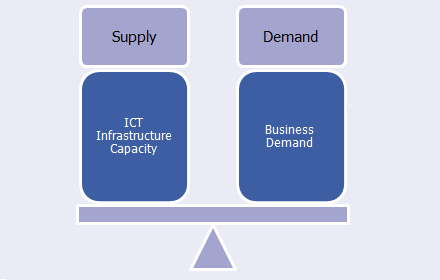
We define Demand as the business demand for the IT services and applications that run on the ICT infrastructure.

Do I Need Capacity Management?
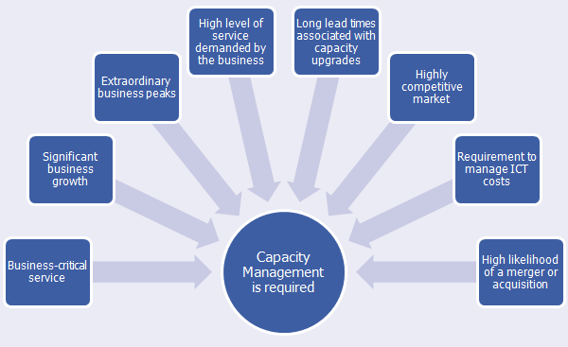
Capacity planning will be beneficial if your organisation meets one or more of the following criteria:
- Frequent innovation; new product launches, changes to existing services, etc.
- Rapid business growth
- Extraordinary peaks
- Desire to reduce ICT costs
- A significant percentage of revenue is dependent on ICT services
- Requirement to reduce the risk of degraded availability of business-critical services
The diagram below shows some criteria to determine whether capacity management is required.
Summary
Capacity management is a powerful risk management technique to ensure the continuity of business services, whilst minimising additional spend on ICT infrastructure.
Capacity management is the classic balance of supply versus demand. Insufficient supply uner peak demand leads to poor user experience. Excess supply leads to expensive ICT.
In the context of increasing cloud adoption, cloud capacity management enables organisations to control their costs and accurately forecast cloud budgets.
cinema

About the author
Danny Quilton

FinOps and AI: Building the Financial Discipline for the Next Wave of Enterprise Intelligence
AI FinOps represents an evolution rather than a replacement of traditional FinOps. It extends the model into a domain where financial, technical, and product decisions are tightly interconnected.

Confidence Under Load: How We Verified AKS Readiness for Peak
How Capacitas verified AKS readiness for peak demand by validating workload performance, autoscaling, cluster capacity, monitoring, and incident response.
Building Cloud Resilience: Lessons from the AWS Outage
Learning from the Latest Outage. Events like this week’s AWS disruption highlight one clear truth: resilience must be designed, not assumed.
Bringing Order to Chaos: A Practical Guide to Chaos Testing in the Cloud
In today’s cloud-native environments, resilience is not optional—it’s critical. Chaos testing has emerged as a key practice for validating system behaviour under failure conditions.