

Blogs

Date 29 June 2026
Would you stare at a screen for hours waiting for your turn?
Customers hate website virtual queues. There's evidence on social media that users are frustrated with virtual queues. Academic research shows big queues means customers are more likely to leave.
During Covid-19, websites saw an increase in demand and crashed. Companies rushed to install virtual queues to protect websites. Queues reached over a quarter of million [1], wait times more than 2 hours [2]. I personally wouldn’t stare at a screen for hours waiting for my turn.
With long queues, websites would have lost revenue and harmed their brand.
Your customers hate virtual queues
Virtual queuing vendors say it creates a sense of urgency, which increases conversion rates. [5] The reality is social media and academic research say the opposite[6].
Customer experience is poor. There are thousands of twitter posts of customer complaining about virtual queues. They may be waiting, but they are not loving it. The counter argument is that those who do wait will buy. That ignores all the people who would have purchased but weren’t willing to wait.
Virtual queuing vendors’ own surveys say 80% percent of customers will wait in a queue up to one hour. That means 20% of customers don’t wait[3].
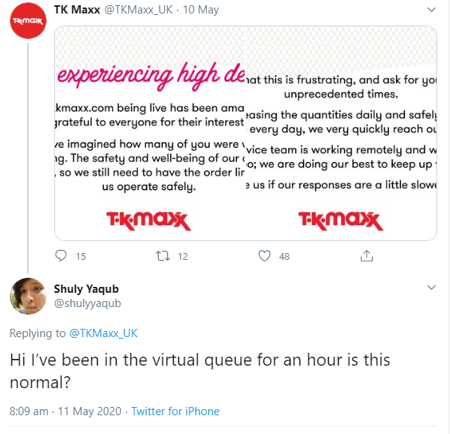 https://twitter.com/shulyyaqub/status/1259742441537703936?s=20
Queues show customers they’re not important
Scientific research shows in big queues, even more customers give up. [5]&[6] Work by Pender writes:
“.. the number of people who would ultimately abandon a virtual queue depends quadratically on the queue length.”
That means the bigger the queue, the faster the rate of abandonment. Which means lost revenue.
While there's no research yet, the evidence from social media shows that collateral brand damage is being inflicted. And the shame is that it's unnecessary.
You can ditch the queue
IT departments will tell you they need virtual queues to stop their websites from crashing. That may have been true years ago. Now, most companies can scale their websites without them. One client scales their website to support hundreds of thousands of users.
So, how do you avoid virtual queuing and handle peak demands more elegantly? That’s part 2 in this series of briefings. How you can safely avoid using virtual queuing?
References
[1] https://www.business2community.com/marketing/re-aligning-marketing-and-customer-loyalty-for-retailers-during-the-coronavirus-02293236
[2] https://www.bristolpost.co.uk/whats-on/shopping/bq-queue-online-shopping-wait-4038028
[3] https://queue-it.com/blog/why-smart-marketers-put-shoppers-in-online-queue/
[4] https://www.fierceretail.com/digital/shoppers-willing-to-wait-hour-for-e-commerce
[5] https://research.cornell.edu/news-features/waiting-line
[6] https://cpb-us-e1.wpmucdn.com/blogs.cornell.edu/dist/3/7882/files/2018/06/correlation-23ngfyo.pdf
[7] https://edition.cnn.com/2020/03/19/business/grocery-shopping-online-coronavirus/index.html

About the author
Team Capacitas
FinOps and AI: Building the Financial Discipline for the Next Wave of Enterprise Intelligence
AI FinOps represents an evolution rather than a replacement of traditional FinOps. It extends the model into a domain where financial, technical, and product decisions are tightly interconnected.
Confidence Under Load: How We Verified AKS Readiness for Peak
How Capacitas verified AKS readiness for peak demand by validating workload performance, autoscaling, cluster capacity, monitoring, and incident response.
Building Cloud Resilience: Lessons from the AWS Outage
Learning from the Latest Outage. Events like this week’s AWS disruption highlight one clear truth: resilience must be designed, not assumed.
Bringing Order to Chaos: A Practical Guide to Chaos Testing in the Cloud
In today’s cloud-native environments, resilience is not optional—it’s critical. Chaos testing has emerged as a key practice for validating system behaviour under failure conditions.