

Blogs

Date 29 June 2026
We recently discussed why it's so essential to prepare early for peak sales periods. But to ensure you can maintain great service during traffic peaks, there is a lot to consider. Another key tactic is to set (and meet) relevant, smart targets.
Set Targets
Let’s say we have a big sales promotion coming up for our web site. How are we going to measure success? It’s too simple to define success as achieving the demand targets. Achieving sales targets is a very short-sighted measure of success if a proportion of customers experience slow page loads, have to wait in a queue, or struggle to to access the site at all.

Customers who have a poor experience are less likely to return to the web site.
In order to plan for big peaks we must first define service achievement targets.
For web sites this is best structured along these lines:
“X% of the time, during the peak period, the page load time of key web site pages should be Y seconds or less.”
How do we decide what Y should be? There are two tools at our disposal:
- We know from our previous research that there is a clear link between the conversion rates for online shops and the page load time. For some sites, once page load time exceeds as little as 2 seconds the conversion rate drops by up to 2.6 percentage points for every additional second.
- You can benchmark your competitors. In the below example, a page load time of 3 seconds would provide a better customer experience than offered by three competitors
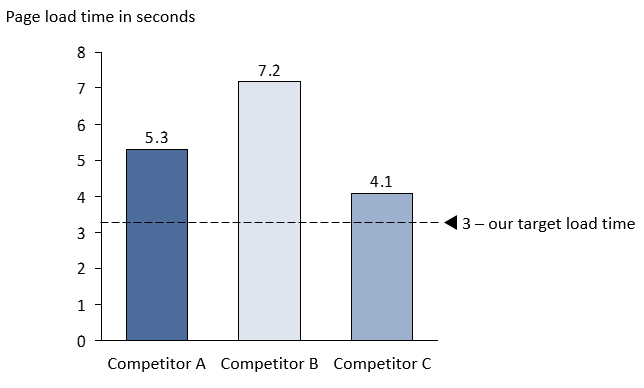
How should we decide what X should be? Well that depends on the criticality of the website. For an online share trading platform, this might be 99%, whereas a non-critical platform may be comfortable with 90%. Ultimately, this is a business decision.
Here’s an example of what a demand statement may look like once we’ve completed our analysis:
“95% of the time, during the peak period, the page load time of key web site pages should be 3 seconds or less.”
Summary
Now we have clear targets, we can plan and test to them. As we prepare for the peak period, we can unambiguously report whether we are on target or not.
For a more detailed look into how we can help businesses prepare for peak get in touch, or refer to our in-depth capacity planning page.
If you would like to learn more about our Prepare for Peak and Performance testing solutions, please click below, to see our latest Ebook.

About the author
Team Capacitas

FinOps and AI: Building the Financial Discipline for the Next Wave of Enterprise Intelligence
AI FinOps represents an evolution rather than a replacement of traditional FinOps. It extends the model into a domain where financial, technical, and product decisions are tightly interconnected.

Confidence Under Load: How We Verified AKS Readiness for Peak
How Capacitas verified AKS readiness for peak demand by validating workload performance, autoscaling, cluster capacity, monitoring, and incident response.
Building Cloud Resilience: Lessons from the AWS Outage
Learning from the Latest Outage. Events like this week’s AWS disruption highlight one clear truth: resilience must be designed, not assumed.

Bringing Order to Chaos: A Practical Guide to Chaos Testing in the Cloud
In today’s cloud-native environments, resilience is not optional—it’s critical. Chaos testing has emerged as a key practice for validating system behaviour under failure conditions.