

Blogs
Date 29 June 2026
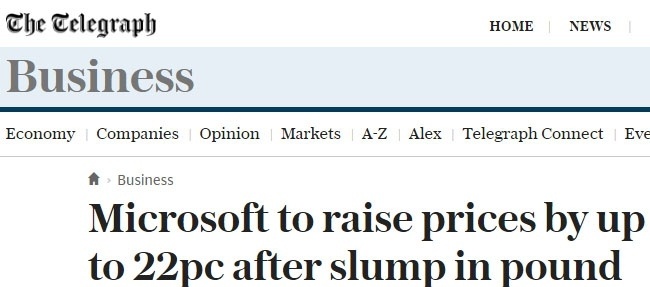
Do you like predictability in your life? Imagine that you are a CIO or CTO that has recently completed a migration to cloud services, and has finalised your 2017 IT budget. Well today you are in for a nasty shock: Microsoft is increasing its Sterling prices by 22% to its U.K. customers, due to the move in the dollar:sterling exchange rate since the 'Brexit' referendum.

The Telegraph reported:
"[Sterling] Costs for Microsoft enterprise customers will increase by 13pc for computer software and 22pc for so-called online cloud services, where the company hosts a customer’s data in a virtual storage centre."
Microsoft provides many businesses with cloud-based services, such as Azure for hosted services and Office 365 for productivity. At this stage of the year you have probably set your IT budget for 2017. This announcement has just blown your budget wide open again.
If you are that CIO or CTO who sold the benefit of cloud services to your company's board, then today you will be scheduling a difficult conversation with your CFO.
Because of variable demand, and elastic pricing, budgeting for cloud services is difficult enough anyway. When a major global supplier with a captive audience suddenly increases prices by nearly a quarter, with only 2 months' notice, it makes the budgeting process even more uncertain.
Cloud services bring many benefits, but unlike in-house hosting you are always reliant on an external supplier who has their own cost pressures.
Remember: You can outsource server provisioning, operations and maintenance, but you cannot outsource risk.
Your only consolation? Our research has uncovered that most businesses have vastly over-provisioned server capacity, even in the cloud. It should be easy for large businesses to recover this 22% from consolidation. However, for many of you in smaller businesses cost saving is not that easy: you are probably using Office 365, these costs relate directly to staff numbers – which cannot be rationalised so easily.
If you need advice on significantly reducing your server hosting costs then please contact us.

About the author
Team Capacitas
FinOps and AI: Building the Financial Discipline for the Next Wave of Enterprise Intelligence
AI FinOps represents an evolution rather than a replacement of traditional FinOps. It extends the model into a domain where financial, technical, and product decisions are tightly interconnected.

Confidence Under Load: How We Verified AKS Readiness for Peak
How Capacitas verified AKS readiness for peak demand by validating workload performance, autoscaling, cluster capacity, monitoring, and incident response.
Building Cloud Resilience: Lessons from the AWS Outage
Learning from the Latest Outage. Events like this week’s AWS disruption highlight one clear truth: resilience must be designed, not assumed.
Bringing Order to Chaos: A Practical Guide to Chaos Testing in the Cloud
In today’s cloud-native environments, resilience is not optional—it’s critical. Chaos testing has emerged as a key practice for validating system behaviour under failure conditions.