

Blogs
Date 08 January 2024
When it comes to reducing costs on AWS, everyone focuses on EC2, EBS and S3 because they are some of the most commonly used services in AWS infrastructure. While these services are usually the outliers for rising costs, it is important to take a comprehensive approach to cost optimisation and not just focus on the basic services for large environments.
By taking a broader view of the entire infrastructure and understanding how different services interact and how they are driven by demand, companies can not only identify areas for optimisation but also improve performance, reduce downtime, and enhance user experience.
Here are some top tips on how to optimise other AWS services:
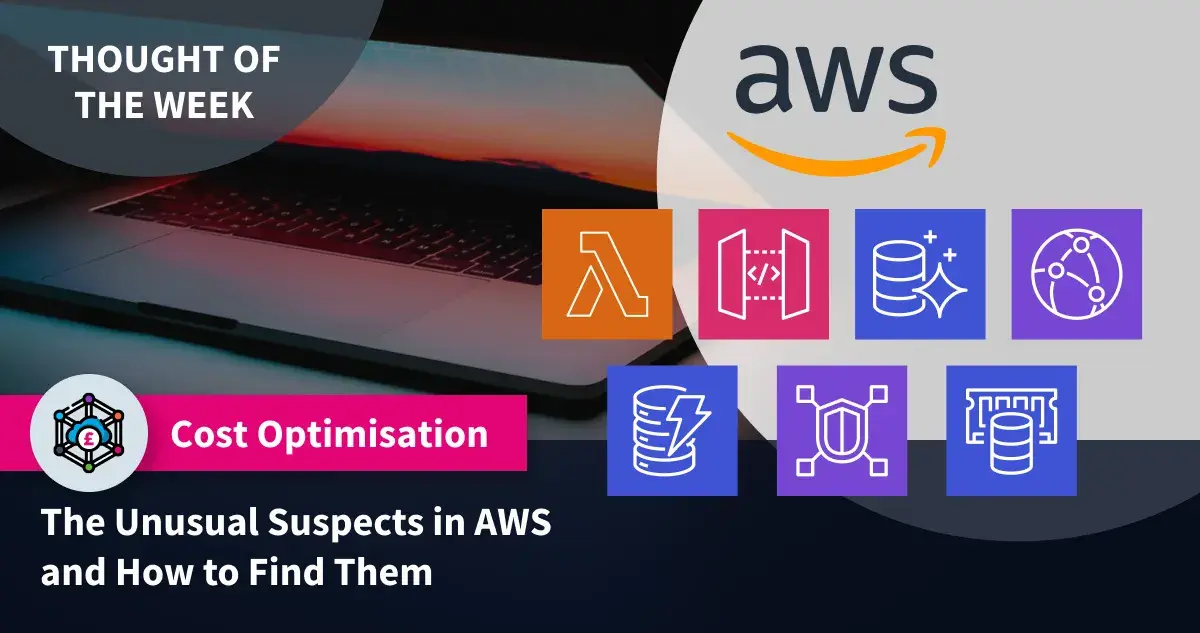
- Lambda: Set a concurrency limit, optimise code, and reduce dependencies to ensure your function does not spawn more instances than required.
- API (Application Programming Interface) Gateway: Use caching, throttling, and CDNs to reduce the number of API calls and minimize costs.
- Aurora: Choose the right instance type and storage, use reserved instances, and autoscaling to ensure you have the right capacity and avoid unused resources.
- ElastiCache: Use data compression, eviction policies, and right-sized cache nodes to optimize costs.
- DynamoDB: Choose the right provisioned throughput and data storage configuration based on your application's needs.
- VPC: Use VPC endpoints to avoid data transfer costs and right-size your VPC based on your application's needs.
- CloudFront: Use caching and edge locations to minimize the number of requests to origin servers and reduce data transfer costs.
Remember to monitor usage patterns regularly against the demand signal to identify areas for optimisation and make informed decisions about resource allocation. This can ensure the company is optimised for both cost and performance.
By implementing these recommendations, companies can curb unnecessary expenses while also improving overall efficiency, minimizing downtime, and elevating user experiences. The constant monitoring of usage patterns against demand signals ensures that the organization remains agile, making informed decisions about resource allocation.
A comprehensive approach to AWS cost optimization goes beyond the basics, ensuring that the unusual suspects are identified and addressed, leading to a well-balanced and optimized cloud infrastructure.
Also worth having a look at some of our recent case studies where we have saved our clients Millions of pounds in cloud spend.



About the author
Ram Sharma

FinOps and AI: Building the Financial Discipline for the Next Wave of Enterprise Intelligence
AI FinOps represents an evolution rather than a replacement of traditional FinOps. It extends the model into a domain where financial, technical, and product decisions are tightly interconnected.

Confidence Under Load: How We Verified AKS Readiness for Peak
How Capacitas verified AKS readiness for peak demand by validating workload performance, autoscaling, cluster capacity, monitoring, and incident response.
Building Cloud Resilience: Lessons from the AWS Outage
Learning from the Latest Outage. Events like this week’s AWS disruption highlight one clear truth: resilience must be designed, not assumed.
Bringing Order to Chaos: A Practical Guide to Chaos Testing in the Cloud
In today’s cloud-native environments, resilience is not optional—it’s critical. Chaos testing has emerged as a key practice for validating system behaviour under failure conditions.