

Blogs
.png)
Date 07 August 2018
The global public cloud market will hit $178 billion this year, up some $32bn from 2017, while public cloud adoption is set to exceed 50% for the first time ever. However, while the general move away from clunky on-site infrastructure is a positive development, it brings with it a whole new set of challenges.
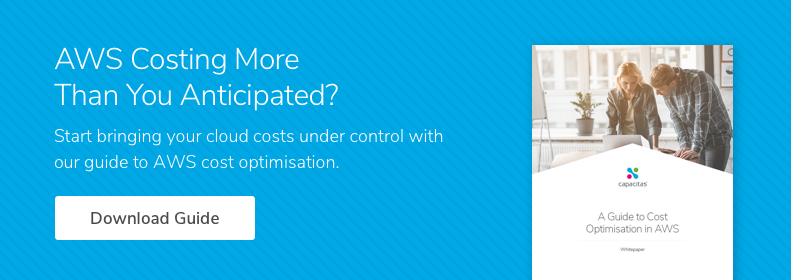
Chief among these is cost optimisation. In their haste to access the benefits of switching to a cloud-based architecture, many businesses have found they aren’t adequately prepared to track and manage their cloud spending — leading to unexpected costs for some. Our new whitepaper analyses some of the reasons for cloud-overspend and lays out a simple framework for managing it.

What’s in the Whitepaper?
While the whitepaper is centred on optimising costs for AWS (Amazon Web Services) — as
In the whitepaper we cover:
The Key Drivers of Overspending in AWS
We dig deeper into the 5 biggest challenges posed by AWS cloud cost management and how each acts as a key driver of cost-inefficiency, namely:
- Over-sizing
- Software inefficiency
- Sub-optimal architecture
- Inelasticity
- Forecasting complexity
How Can We Optimise AWS Costs?
After analysing each driver and explaining why they cause cloud-overspend, we show you a relatively simple way to address the first 4 drivers of cost-inefficiency. These 4 factors are responsible for 70% on average of all cost optimisation opportunities in the cloud. So, by tackling these 4 first you’re well on the way to optimising the bulk of your cloud costs.
We lay out a simple 6-step process for tackling the simple stuff, explaining in turn how to:
- Identify over-supply and software inefficiency
- Assess the risks and likely costs of optimising those inefficiencies
- Plan your optimisation and successfully test it
- Implement your optimisation in a live setting
- Validate the optimisation’s performance
- Remove technical constraints
Following this process should enable you to cut a large proportion of the wastage and hidden costs of cloud usage. However, cloud-cost optimisation doesn’t end there. The fifth challenge outlined in our whitepaper — forecasting complexity— is where a further 30% of cost-inefficiencies are to be found, as businesses increasingly struggle to predict the OPEX costs associated with the cloud.
To reach these more deeply ingrained strategic challenges takes something beyond the approach we’ve outlined in the whitepaper. At
To learn more about our approach and pick up a few useful tips on where to get started on your cost optimisation with some easy fixes, download our new whitepaper.

About the author
Danny Quilton

FinOps and AI: Building the Financial Discipline for the Next Wave of Enterprise Intelligence
AI FinOps represents an evolution rather than a replacement of traditional FinOps. It extends the model into a domain where financial, technical, and product decisions are tightly interconnected.

Confidence Under Load: How We Verified AKS Readiness for Peak
How Capacitas verified AKS readiness for peak demand by validating workload performance, autoscaling, cluster capacity, monitoring, and incident response.
Building Cloud Resilience: Lessons from the AWS Outage
Learning from the Latest Outage. Events like this week’s AWS disruption highlight one clear truth: resilience must be designed, not assumed.
Bringing Order to Chaos: A Practical Guide to Chaos Testing in the Cloud
In today’s cloud-native environments, resilience is not optional—it’s critical. Chaos testing has emerged as a key practice for validating system behaviour under failure conditions.