

Blogs

Date 29 June 2026
When preparing a web site for peak, it is critical to look at the entire service and to ensure you haven't forgotten or overlooked any third party elements.
Eliminate Risk from Third-Party Systems
Modern web sites are complex and interconnected with multiple third-party systems, for example:
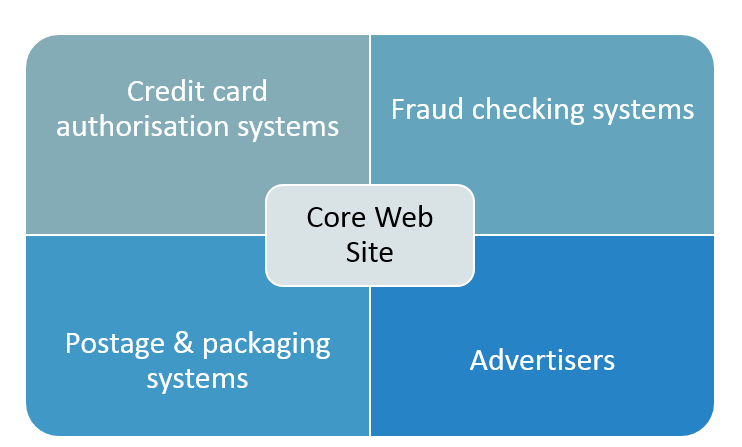

If third-party systems slow down or fail during peak shopping times your customers will have a poor experience
Such third-party systems are out of your control, however your web site depends upon them. If any of these systems slow down or, worse still, crash during peak shopping times your customers will have a poor experience and may even decide to leave the site completely.

Too often we’ve seen our clients’ web sites completely fail due to instability introduced by the slow-down or failure of a third party.
Of course the customer won’t care, or even realise, if the crash was caused by a third party, and the blame will be laid solely at your feet.
The ramifications of this are well documented:
- Reduction in conversion
- Customer churn
- Reputational damage
What strategies can we use to Reduce Risk in Third Parties?
1. Assess the Risk
The risks associated with third-parties should be identified, scored and prioritised using performance analysis of recent historical peaks.
2. Implement Service Management
Implement a service management process to review the historical performance of the third-party on a regular basis, including:
- Incidents
- Problems
- Service performance over recent peak periods
3. Build resilience
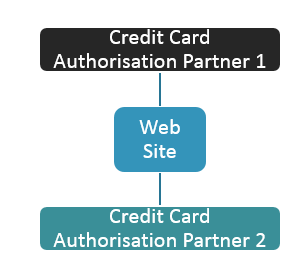
In the simple example below, we have 2 different, diverse credit card authorisation partners. A design goal should include the ability to shape what volume goes to each and make changes to this rapidly. If one crashes or slows down, the other can take the slack.
4. Decouple
It is important to decouple your web site from the third-party in such a way that failures on their end do not create instability in your site's core functions.
5. Implement Governance
"How can we be confident that the third party won’t slow down or crash during the all-important sales promotion that’s coming up? They said they can handle our peak order volume, but how can we be sure?"
Implementing a governance process will reduce the risk of crashes in the future. A governance process should answer the following questions:
- Can they handle your peak?
- Can they handle your peak and their other clients’ at the same time? This is essential for universal peak periods such as Black Friday and Christmas.
- What risk identification and mitigation have they conducted? The evidence of this should be shared, i.e. the methodology and the outputs.
6. Implement Service Level Agreements
Service level agreements (SLAs) define what is expected from the third party’s service. Too often we see clients with inadequate protection. Availability targets alone are not sufficient. In a recent article, we define what an SLA should include.
If you would like to learn more about our Prepare for Peak and Performance testing solutions, please click below, to see our latest Ebook.

About the author
Team Capacitas

FinOps and AI: Building the Financial Discipline for the Next Wave of Enterprise Intelligence
AI FinOps represents an evolution rather than a replacement of traditional FinOps. It extends the model into a domain where financial, technical, and product decisions are tightly interconnected.
Confidence Under Load: How We Verified AKS Readiness for Peak
How Capacitas verified AKS readiness for peak demand by validating workload performance, autoscaling, cluster capacity, monitoring, and incident response.
Building Cloud Resilience: Lessons from the AWS Outage
Learning from the Latest Outage. Events like this week’s AWS disruption highlight one clear truth: resilience must be designed, not assumed.
Bringing Order to Chaos: A Practical Guide to Chaos Testing in the Cloud
In today’s cloud-native environments, resilience is not optional—it’s critical. Chaos testing has emerged as a key practice for validating system behaviour under failure conditions.