

Blogs

Date 22 April 2023
With a massive mismatch between supply and demand, the price of oil has collapsed to record lows. In its wake, oil & gas companies are having a tough time and will be looking to reduce their cost base, including IT.
We have seen cloud spend represent 20-30% of IT budgets. Oil & gas organisations will have significant cloud footprints across their systems in upstream, downstream and trading.
Typically teams will implement cost reduction using the FinOps model. But in our experience these will only achieve 20% of the potential savings.
80% of potential cloud savings are left on the table - even when you have great technical teams internally
Yes, 80%. Take a look at the data from a recent cloud optimisation engagement:
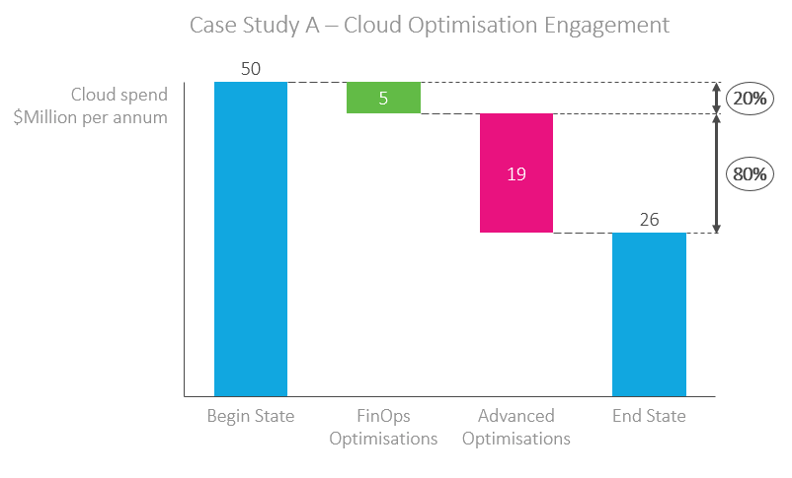 That's because these require advanced optimisation techniques that go way beyond FinOps approaches such as right-sizing, negotiation, savings-plans and cost management tools.
Don't get me wrong, FinOps techniques are perfect in technology-as-usual situations but not in the crisis that the Oil industry faces today.
The trouble is, it is hard to win that 80% of saving, even when you have great technical teams....
Advanced optimisations are difficult to achieve in most organisations for three reasons:
- Lack of methodology & detailed insight to understand how efficiently applications consume cloud resources.
- Staff responsible for cloud cost tend to be naturally conservative and risk-averse.
- Lack executive sponsorship means nobody is driving change.
The first point is only possible when you have a highly specialised knowledge base and depth of experience. Something which most organisations don't have and therefore find it hard to comprehend why such massive savings are possible. If you are interested in finding out more, take a look at this webinar.
In our experience, the staff responsible for implementing cost improvements are naturally concerned that any change will adversely impact the stability of the applications. Those who operate FinOps do not have the depth of expertise to assess the trade-off between performance and capacity. With the right methodology and insight, concerns around application stability can be tackled.
Finally, to achieve the 80%, it is crucial to have executive sponsorship to go after the more difficult optimisations. Understandably, in the past this was not priority.
But now should be the time to commit the resources and time needed.

About the author
Danny Quilton
FinOps and AI: Building the Financial Discipline for the Next Wave of Enterprise Intelligence
AI FinOps represents an evolution rather than a replacement of traditional FinOps. It extends the model into a domain where financial, technical, and product decisions are tightly interconnected.
Confidence Under Load: How We Verified AKS Readiness for Peak
How Capacitas verified AKS readiness for peak demand by validating workload performance, autoscaling, cluster capacity, monitoring, and incident response.
Building Cloud Resilience: Lessons from the AWS Outage
Learning from the Latest Outage. Events like this week’s AWS disruption highlight one clear truth: resilience must be designed, not assumed.
Bringing Order to Chaos: A Practical Guide to Chaos Testing in the Cloud
In today’s cloud-native environments, resilience is not optional—it’s critical. Chaos testing has emerged as a key practice for validating system behaviour under failure conditions.