

Blogs

Date 29 June 2026
Introduction
Here at Capacitas we are extremely interested in how performance affects the bottom line of our clients. After all, if tuning your services does not deliver for your customers, why do it?
Online retailing is a highly competitive business, with customers merely a click or two from a competitor. Therefore, a responsive, engaging site is key to retaining your customers.
But is it possible to quantify the effect of a site slowing down?
- Are customers “sticky”, and prepared to persevere through to finalising their order?
- Or do they give up, and bail out to another site?
How much does a slowdown in responses affect the bottom line? We are particularly interested in the impact of a relatively small increase in response times, with no SLAs breached. This will help quantify the value of modest improvements.
The Analysis
We recently had the opportunity to compare order rates and response times, during a planned outage for a content delivery network. Site speed took a short hit, and the service returned to normal as the cache repopulated. We were able to capture the orders rates during this event, and compare this with the relative numbers for that same weekday with normal response times.
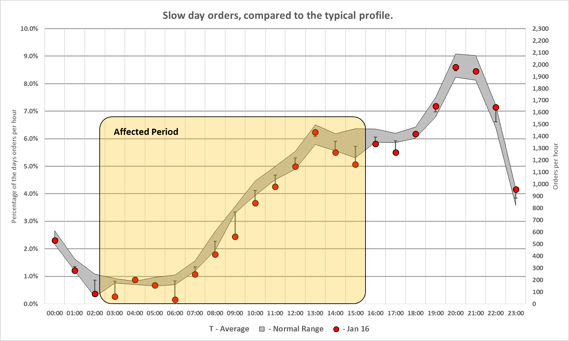
By the evening, when response times had improved to 1 second, (still above normal), there was no significant loss of orders.

Response times of up to 1 second are “good enough”.
We also performed a regression, to put the
analysis on a sound statistical basis. Here is the chart of the results.
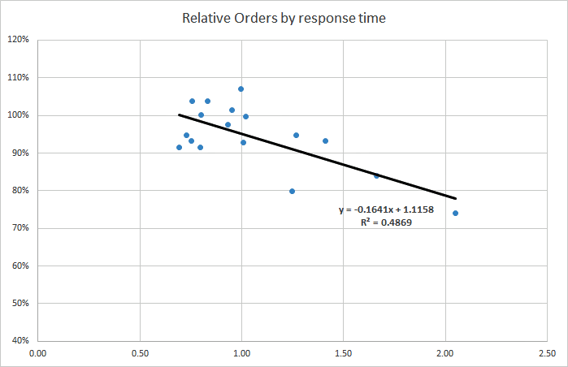
The downward slope is very clear.
An increase of 1 second in response time led to a 16% reduction in orders.
Note that this research is very much in line with other, similar cases we have analysed. See this article:
Other factors and effects.
Some online retails claim their customers are very “sticky” and unlikely to switch to an alternate. This may be true in some cases – after all, you cannot use a different bank’s web site to access your account.
But Capacitas research clearly shows that this cannot be safely assumed.
And even if the users do persevere to complete their order, the odds of them returning are surely reduced if they have an unsatisfactory experience. Also, it is worth remembering that Google search rankings take site responsiveness into account, so a slugish site means customers are less likely to be directed to your site in the first place.
And if you have an extreme annual peak, (such as Black Friday), it is even more important that response times hold up under high demand, or considerable revenue can be easily lost. Preparing for peak, and ensuring good service under load, is extremely important to your profitability.
if you would like to learn more about our Prepare for Peak and Performance testing solutions, please click below, to see our latest Ebook.

About the author
Team Capacitas

FinOps and AI: Building the Financial Discipline for the Next Wave of Enterprise Intelligence
AI FinOps represents an evolution rather than a replacement of traditional FinOps. It extends the model into a domain where financial, technical, and product decisions are tightly interconnected.
Confidence Under Load: How We Verified AKS Readiness for Peak
How Capacitas verified AKS readiness for peak demand by validating workload performance, autoscaling, cluster capacity, monitoring, and incident response.
Building Cloud Resilience: Lessons from the AWS Outage
Learning from the Latest Outage. Events like this week’s AWS disruption highlight one clear truth: resilience must be designed, not assumed.
Bringing Order to Chaos: A Practical Guide to Chaos Testing in the Cloud
In today’s cloud-native environments, resilience is not optional—it’s critical. Chaos testing has emerged as a key practice for validating system behaviour under failure conditions.