
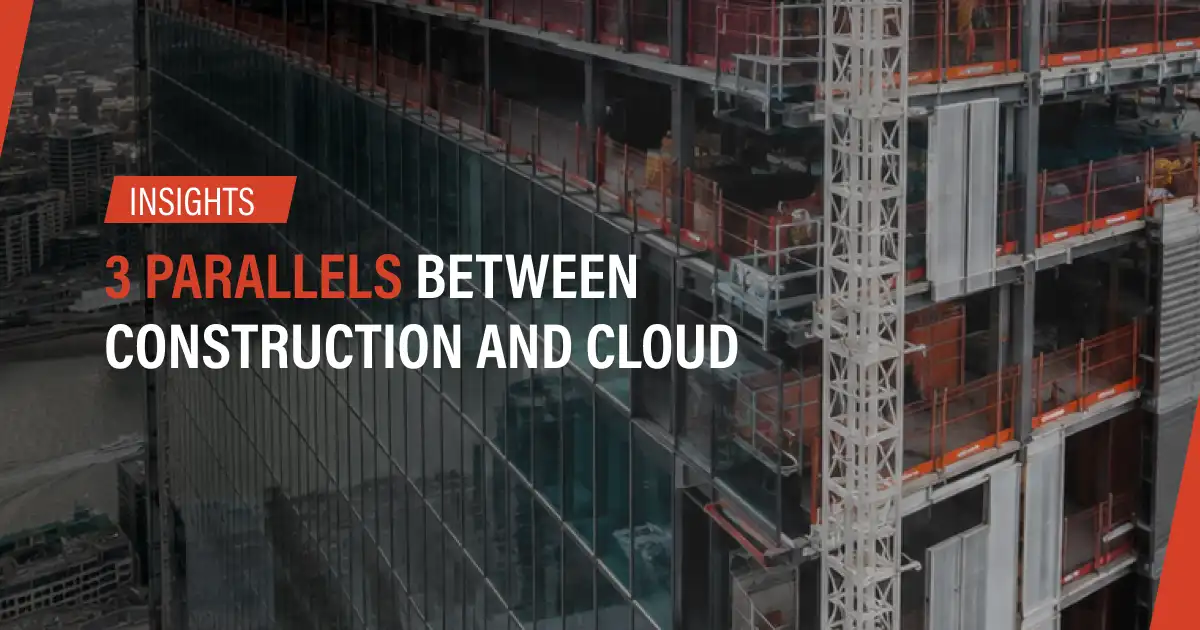
As a recent mover from the construction industry into the tech world, I have a somewhat unique perspective on what we do at Capacitas and as an industry. I spent the first four years of my career as a Mechanical Engineer, delivering critical cooling systems for data centre projects, before pivoting into building control systems, and ultimately joining Capacitas.
Despite my title, role and industry changing over this time, there are underlying themes that are surprisingly consistent throughout, and apply in both construction and the realm of cloud computing.
Careful design is key
In construction, systems must be designed with the end-user in mind – poor design leads to inefficiencies, costly rework, and operational headaches. Cloud infrastructure is the same; if you don’t consider your requirements properly, you'll end up with unscalable systems, unnecessary costs, and performance bottlenecks that are expensive to fix down the line.
Testing under load is a must
Just as pipework, cables and equipment must be tested on a construction site, so too must servers, APIs and databases in the cloud. If you’re not testing workloads to their limits before going live, you’re leaving performance, resilience, and user experience to chance.
Balancing cost and performance
A cooling system that is too big wastes energy; one that is too small can’t keep up with demand. The same principle applies in the cloud. Over-provisioning compute, storage, or network resources will lead to unnecessary costs, while under-provisioning causes performance to drop-off just when you need it most. The key is balancing resources with actual demand – not just throwing more power at a problem.
Final thought
At the core of it all, a well-architected cloud environment is like a well-designed building system – planned properly, tested thoroughly, and optimised for efficiency.
If you’d like to find out more about what we do here at Capacitas, get in touch today.
About the author
Ben Pollins
FinOps and AI: Building the Financial Discipline for the Next Wave of Enterprise Intelligence
AI FinOps represents an evolution rather than a replacement of traditional FinOps. It extends the model into a domain where financial, technical, and product decisions are tightly interconnected.
Confidence Under Load: How We Verified AKS Readiness for Peak
How Capacitas verified AKS readiness for peak demand by validating workload performance, autoscaling, cluster capacity, monitoring, and incident response.
Building Cloud Resilience: Lessons from the AWS Outage
Learning from the Latest Outage. Events like this week’s AWS disruption highlight one clear truth: resilience must be designed, not assumed.
Bringing Order to Chaos: A Practical Guide to Chaos Testing in the Cloud
In today’s cloud-native environments, resilience is not optional—it’s critical. Chaos testing has emerged as a key practice for validating system behaviour under failure conditions.