

Smart DCC has unique challenges around scaling, performance, and cost. We have targeted to scale out from 4 to 52 million smart metres over a 4-year period, and as a provider of National Infrastructure, our services must be stable and performant.
We are also regulated by Ofgem, to ensure that we provide value for money to our customers. The engagement with Capacitas significantly addressed these 3 pillars for one of our core services.
Working together, we delivered 36% cost avoidance and identified a further additional avoidance opportunity of 17%. At the same time, the engagement pinpointed and removed six critical scalability & performance risks. The engagement also fostered great collaboration between our commercial & technical teams and our technology service providers.
As a result of this engagement, we are confident that the service can scale out cost effectively in the future. We are working with Capacitas to follow the same approach for other core services.
Case Studies


The Data Communications Company (DCC) primary role is to build, operate and enhance the national smart metering network that underpins the transformation of the UK’s energy system – enabling consumers to participate more actively in their energy management and decarbonisation and helping the industry become more agile and competitive. When the rollout of smart meters is completed, there will be around 50 million meters connected to over 30 million homes and small businesses. This will make it the single, biggest communications platform in Britain.
DCC had commissioned the build of a new service. To support this service, it engaged with two vendors, who provided the software and infrastructure services.
There were two primary concerns with the solution:
-
Firstly, the solution's scalability in the context of the 50M smart meter rollout
-
Secondly, the projected cost of scaling for the meter rollout.
DCC wanted to gain a clear and straightforward assessment of the scalability and cost-efficiency of the solution. There was also an immediate requirement to reduce the lifetime cost of scaling the solution in line with the smart meter rollout.
Assuring scalability and cost-efficiency
Our task was to identify scalability optimisations to enable DCC to meet its stability and performance requirements and ensure a cost-effective solution.
Actions taken
We audited the cost, scalability and efficiency of the solution to identify scalability risks and cost reduction opportunities. We then recommended mitigations to address risks and workstreams to take advantage of cost reduction opportunities.
Risks were broken down into immediate, pre-rollout and post-rollout and prioritised accordingly. We then mitigated the immediate and pre-rollout risks and provided recommendations to mitigate the post-rollout risks.
We compared the platform cost between the original solution to the latest solution to identify areas to challenge and investigated the costs of alternative solutions with differing scalability and resilience goals.
We analysed results from system capacity tests to pinpoint scalability risks and quantify compute costs. These were then used to build a predictive model of capacity vs. cost:
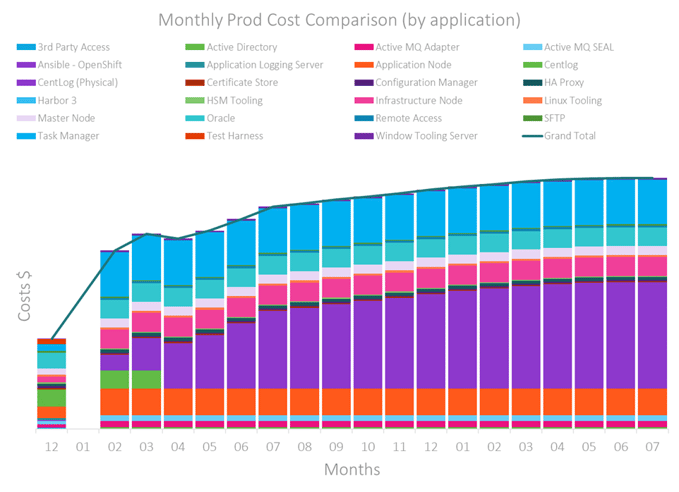
The engagement was successful by building strong relationships with both suppliers and DCC stakeholders - we created and ran a 'Capacity and Performance Working Group' to improve collaboration and define ownership for individual tasks.
Results
A 36% reduction in the year-1 cost was realised, mainly through focusing on optimising a central logging solution. At the same time, analysis and modelling of test results ensured that no further performance testing was carried out, allowing the re-purposing of non-production infrastructure for production use.
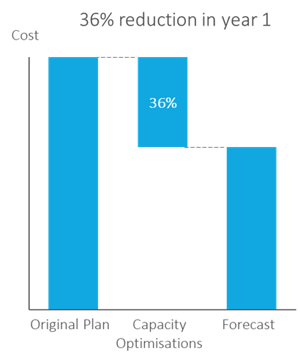
A further 17% of cost avoidance was identified, and a plan to realise these additional optimisations was delivered.
We also pinpointed and eliminated six critical scalability & performance risks, that would have otherwise impeded meter rollout.
Is your infrastructure ready to scale? Partner with Capacitas to unlock efficient, scalable solutions tailored to your growth. Learn more about our approach.

FinOps and AI: Building the Financial Discipline for the Next Wave of Enterprise Intelligence
AI FinOps represents an evolution rather than a replacement of traditional FinOps. It extends the model into a domain where financial, technical, and product decisions are tightly interconnected.
Confidence Under Load: How We Verified AKS Readiness for Peak
How Capacitas verified AKS readiness for peak demand by validating workload performance, autoscaling, cluster capacity, monitoring, and incident response.
Building Cloud Resilience: Lessons from the AWS Outage
Learning from the Latest Outage. Events like this week’s AWS disruption highlight one clear truth: resilience must be designed, not assumed.
Bringing Order to Chaos: A Practical Guide to Chaos Testing in the Cloud
In today’s cloud-native environments, resilience is not optional—it’s critical. Chaos testing has emerged as a key practice for validating system behaviour under failure conditions.